What do you need to use Recagn with Recruit CRM?
You need Recruit CRM's Pro, Business or Enterprise plan or its 30-day trial, a Recruit CRM role that can export candidates, and a Recagn Workspace on a plan. The guide adds two custom fields, and each of those plans has room for them. We tested the round trip in Recruit CRM's trial on 17 Nov 2026.
This is stage 2 to stage 5 of the candidate screening process for recruitment agencies, run from Recruit CRM.
- Recruit CRM:
- Pro, Business or Enterprise, or the trial. Recruit CRM's pricing page gives 15 custom fields on Pro and 100 on Business and Enterprise (read 17 Nov 2026); the guide uses two.
- The Account Owner, an Admin, or a custom role with export access. Team Member roles can't export (Recruit CRM's export help, read 17 Nov 2026).
- Access to Admin Settings, for the two custom fields and Fields Shared With Clients.
- Recagn: a Workspace on a plan with New Candidates parsed left. There is nothing to install.
- A spreadsheet app, to build one five-column CSV.
How does the round trip between Recruit CRM and Recagn work?
Five steps move one job through Recagn and back. Recagn reads the job description and the CVs and runs the interviews; you run the exports, imports and stage changes in Recruit CRM. We ran all five in a Recruit CRM trial on 17 Nov 2026 with made-up candidates and a made-up client, and the figures below are those screens.
- Send the job to Recagn and put its Apply Link in Recruit CRM.
- Export the candidates' CVs and bulk-upload them to Recagn.
- Import each candidate's score and the Company Report link back.
- Move the passing candidates' hiring stage.
- Share the two fields and the shortlist with the client.
Step 1: Send the job to Recagn and put the apply link in Recruit CRM
Recagn reads CVs and scores answers against the role's scorecard, which Recagn calls a rubric, and it drafts the rubric from the job description the Recruit CRM job already holds. Apply Links appear only once the rubric is locked, so the order matters.
- Copy the description from the job's Paste Job Description box in Recruit CRM.
- In Recagn, create a Requirement and paste it. Recagn drafts the rubric and interview questions for you to review before anything goes out.
- Review the rubric, edit what's wrong, and lock it.
- Create an Apply Link. Recruit CRM isn't one of the preset sources, so pick Careers page or type your own label, such as "Recruit CRM".
- Paste the link on the last line of the job description in Recruit CRM, and save.
The role's Recagn apply link sits on the last line of the job description.
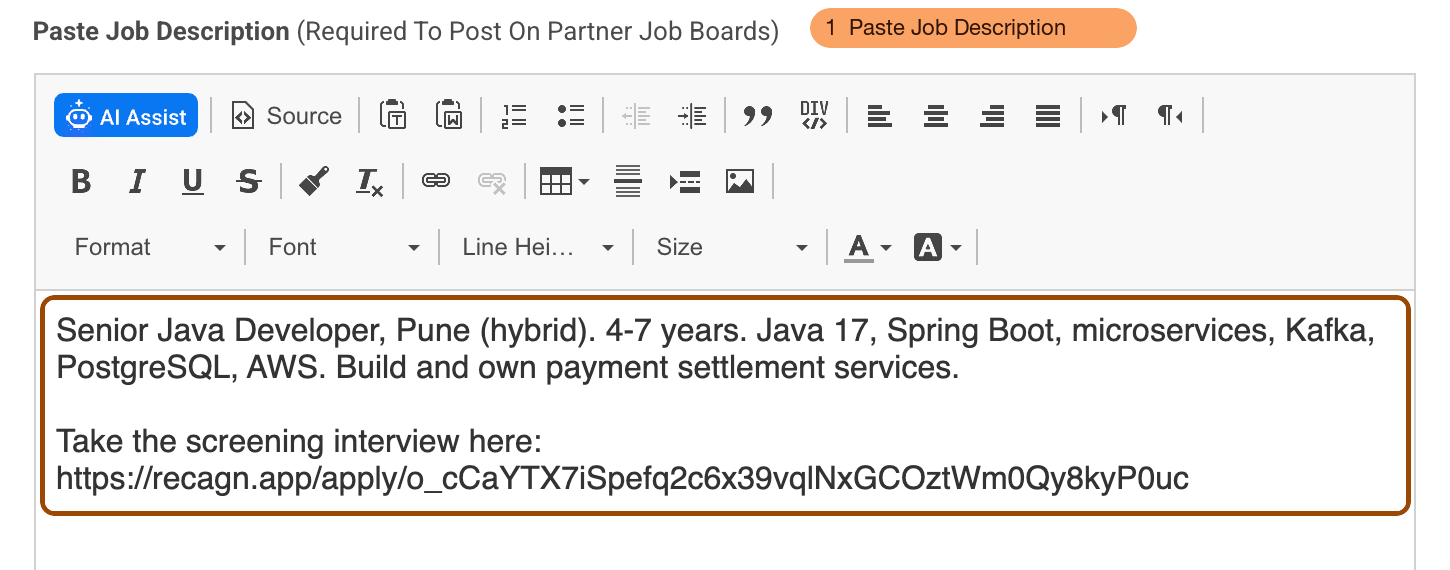
- Paste Job Description Copy the description into a Recagn Requirement, and paste the role's Recagn apply link into it. Recruit CRM's own apply-URL override is account-wide, so it can't point one job at one Recagn link.
A candidate who applies through the link lands in Recagn, and Recagn reads the CV against the rubric. Nobody is interviewed until you invite them.
The link goes in the description because Recruit CRM's Custom Job Application URLs setting applies one format to every job in the account, so it can't point one job at its own Recagn link.
Step 2: Move the candidates' CVs into Recagn
Recruit CRM exports the shortlist and their CVs in one go, as a CSV and a ZIP. Recagn takes the PDF and Word files inside, not the ZIP.
- In Recruit CRM, tick the candidates, then More → Export.
- Tick First Name, Last Name and Email for step 3, and Resume under File Fields.
- Download both files from the notification, unzip the CVs, and move them out of their candidate folders into one folder.
- In Recagn, open Candidates → Bulk upload, choose a Pool, and select every PDF, DOCX and DOC file.
- On the Requirement, run Matching over that Pool. Recagn gives each candidate a match score out of 100. Invite the ones you want to the Interview.
Tick Resume under File Fields to get the CV files with the export.
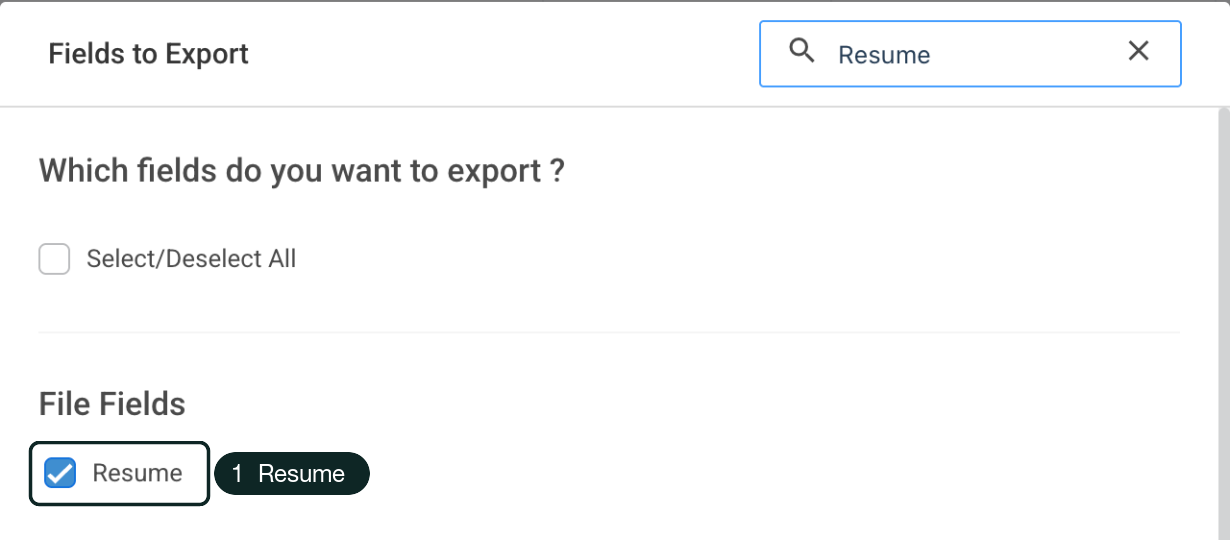
- Resume Select the shortlist, then More, Export. Tick the data fields you need and, under File Fields, Resume. The download is a ZIP with one folder per candidate; gather the files into one folder before the bulk upload to Recagn.
The CVs Recagn reads count against your plan's New Candidates parsed; CVs already in the Workspace don't.
Recagn does the screening. You make the calls: the match score sets the order, and you choose who is invited.
Step 3: Bring the scores and the report link back into Recruit CRM
Two custom fields and one CSV import put each candidate's Recagn score and the Company Report link on their Recruit CRM record, updating the candidates already there.
Make the two fields. You do this once.
- Go to Admin Settings → Candidate Fields → New Custom Field.
- Add "Screening score" as a Number field.
- Add "Screening report link" as a Text field. Recruit CRM has no URL type.
A Number field for the score and a Text field for the report link.
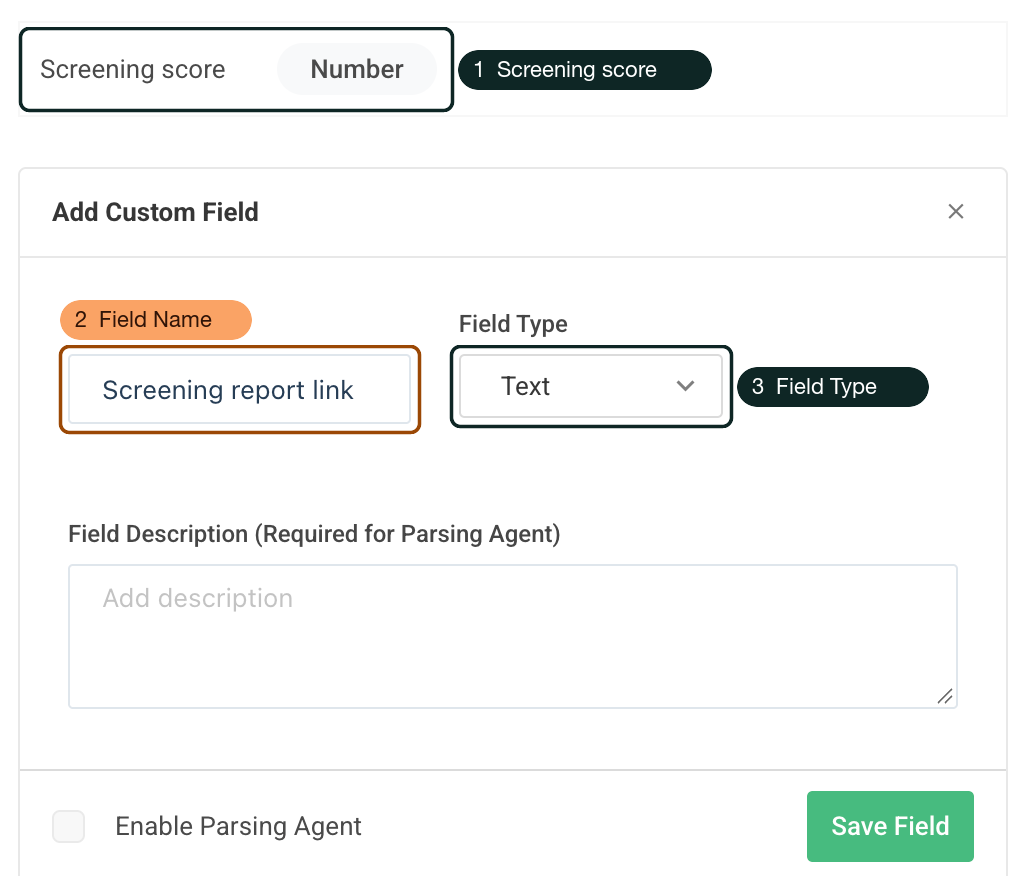
- Screening score Admin Settings, Candidate Fields, New Custom Field: type Number.
- Field Name Name the field for the Recagn Company Report link.
- Field Type Choose Text. There is no URL type, but the link is still clickable on the client's list.
A Text field is enough: the client still gets a link they can click (step 5).
Build the CSV. Recagn has no results export, so you make a five-column file. The CSV you exported in step 2 is a good base, because its names and emails already match Recruit CRM: delete every other column, so the import overwrites nothing else. In the trial we imported a new CSV with the same five headers, which works too.
First NameandLast Name, as exported. Recruit CRM needs First Name even when the import only updates.Email, as exported.Screening score, the candidate's CV match score out of 100. Take it from the "/ 100" figure on the candidate's match detail in Recagn, not from the match list, which can show an adjusted score with a decimal.Screening report link, the Company Report link from Copy link on the Requirement's Report panel. Recagn keeps one live Company Report per Requirement, so the link is the same on every row.
Put in only candidates who completed the Interview, because the report lists only them; add the rest later. The Screening score field holds the match score from the CV read. The interview's scores against the rubric, and Recagn's recommendation, are in the Company Report the link opens.
Import it.
- Go to Candidates → Add Candidate ▾ → Import CSV / XLS and choose the file. Recruit CRM takes CSV or XLS, so save an XLSX as one of those first.
- Map the columns. In the trial, each header mapped to its field by name.
- Choose Merge Duplicates, check duplicates by Email, and switch Override Data on.
- Skip the hotlist and import.
Email is the match key; the score and report-link columns map to the two new fields.
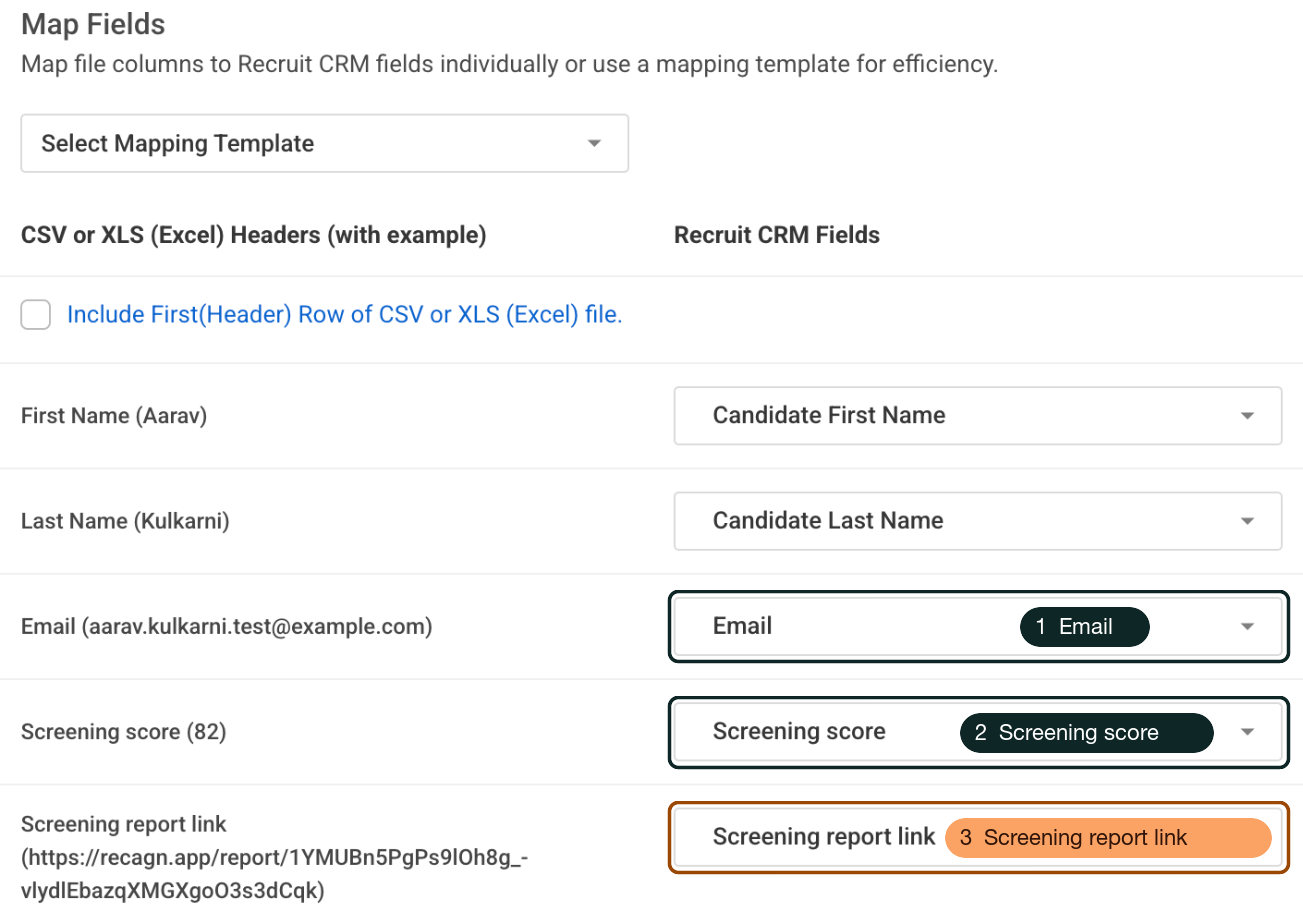
- Email The match key. First Name is required even when you only update, so keep the name columns in the CSV.
- Screening score Maps to the Number field.
- Screening report link The Company Report link, the same on every row.
Merge duplicates found by Email, with Override Data on.
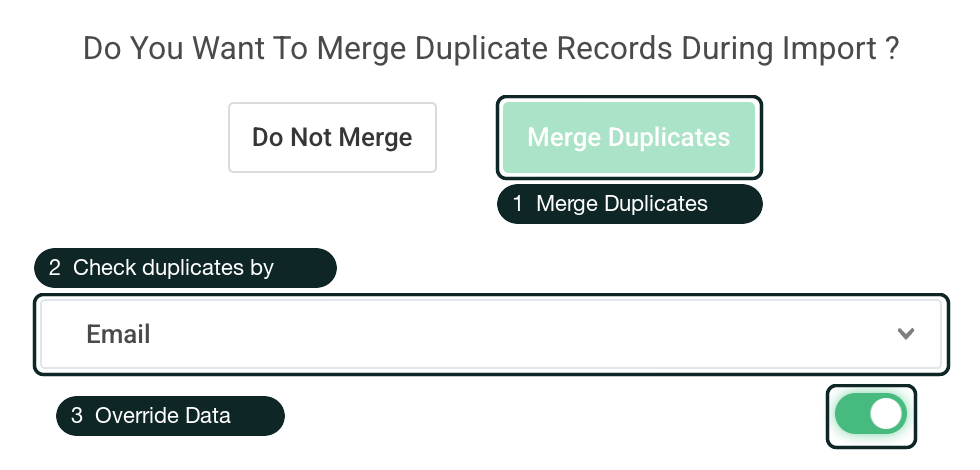
- Merge Duplicates Updates the existing candidates.
- Check duplicates by Email.
- Override Data On replaces values already in the fields, such as an older score. Off only fills empty fields.
Override Data is what lets next week's import replace this week's score.
It reads 0 imported even when every candidate was updated.
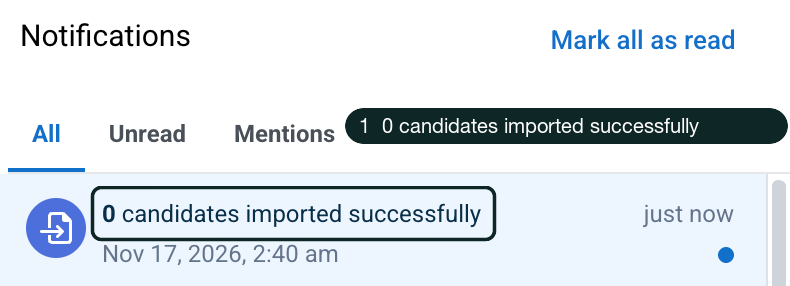
- 0 candidates imported successfully Merged rows aren't counted, so the notice reads 0 even when every candidate was updated. Open one candidate to check the score and link.
The notice counts only new records. To confirm the merge, open any candidate you imported.
Step 4: Move the hiring stage in Recruit CRM
The import can't set the hiring stage: in the trial, the mapping had no stage or job field. So move the stage on the job, several candidates at once.
- Open the job → Candidates Pipeline → View All Candidates.
- Tick the candidates who passed.
- Click Update Hiring Stage.
- Pick the Stage, such as Interview Scheduled, add one Remark/Feedback, which can carry the report link, and submit.
Tick the candidates who passed, set the stage, and add the report link as one remark.
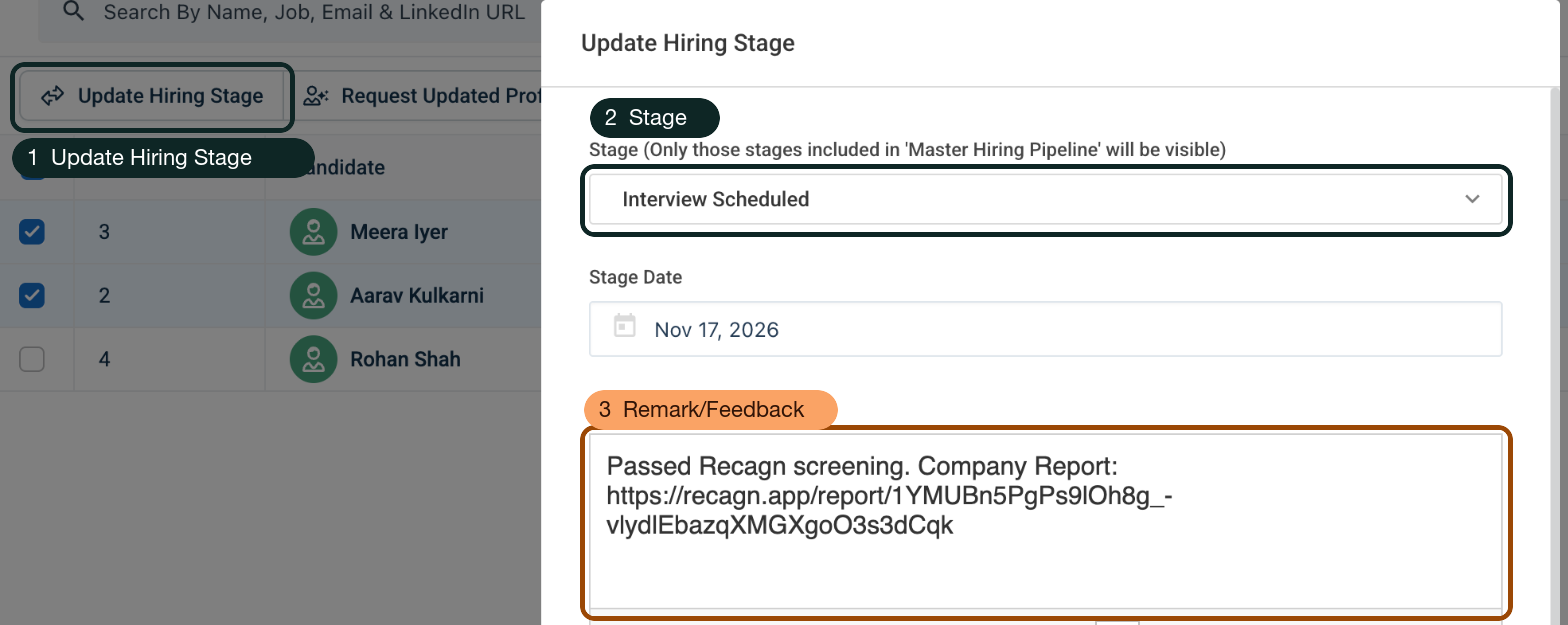
- Update Hiring Stage Job, Candidates Pipeline, View All Candidates; tick those who passed. Import can't set the stage.
- Stage Pick the next stage.
- Remark/Feedback One remark goes on every selected candidate. The client sees it on the Online Candidate List.
Recagn recommends Qualified, Maybe or Disqualified for each candidate it interviews. The stage you set in Recruit CRM is your call.
Step 5: Share the shortlist with the client
Recruit CRM's Online Candidate List gives the client one link to the candidates you choose, showing the fields you share. Share the two screening fields once, and the client can open the Company Report from any candidate.
Share the fields. You do this once, for the whole account.
- Go to Admin Settings → Fields Shared With Clients.
- Tick Screening Report Link and Screening Score.
Tick the report link and the score in Fields Shared With Clients.
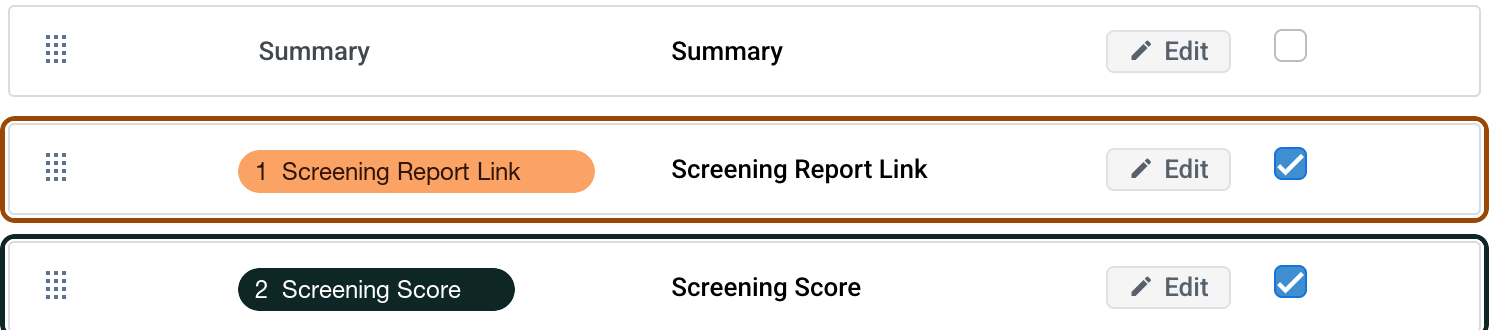
- Screening Report Link Admin Settings, Fields Shared With Clients: tick the report-link field.
- Screening Score And the score.
Choose the candidates and send the list.
- On the job's Candidates Pipeline, switch on Visibility for each candidate the client should see, or use Set Candidates Visibility.
- Click Submit to Client and choose Online Candidate List.
- Copy the link and send it to the client with your own message.
Switch on each candidate's visibility, then Submit to Client.
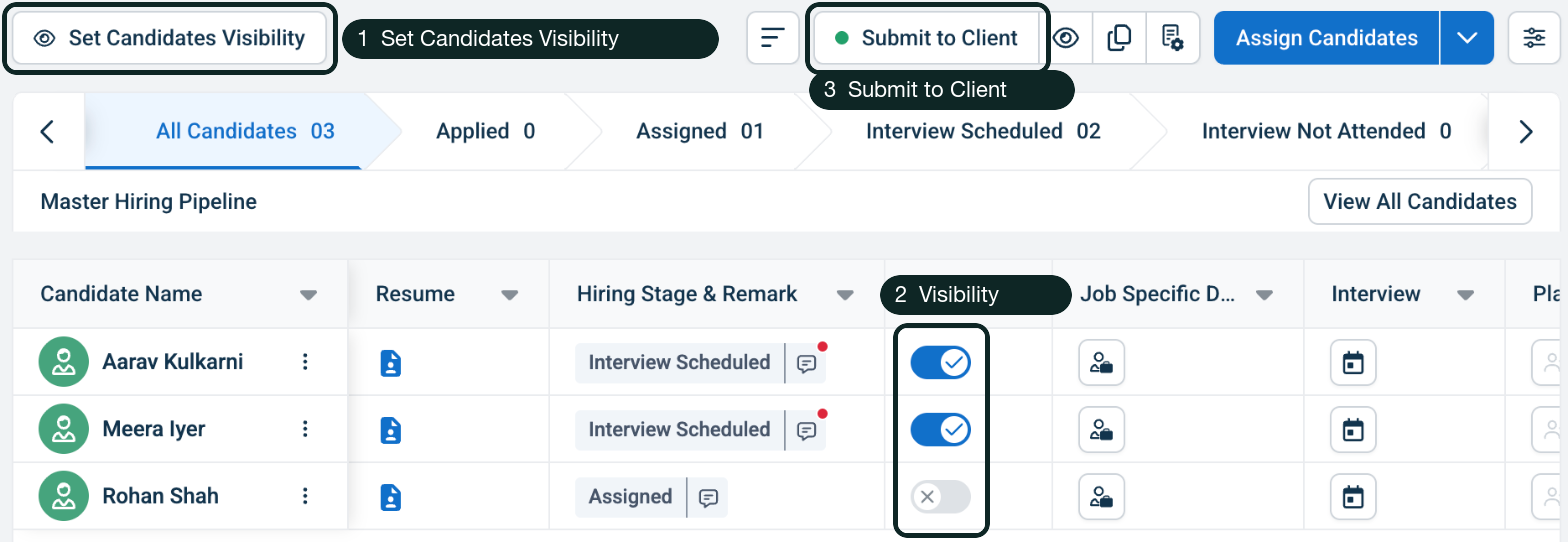
- Set Candidates Visibility Or switch candidates on one by one in the Visibility column.
- Visibility The client's list is empty until a candidate's switch is on.
- Submit to Client Choose Online Candidate List and copy its link for the client. You can skip the prompt to connect email.
The report link is clickable on the client's candidate list, next to the score.
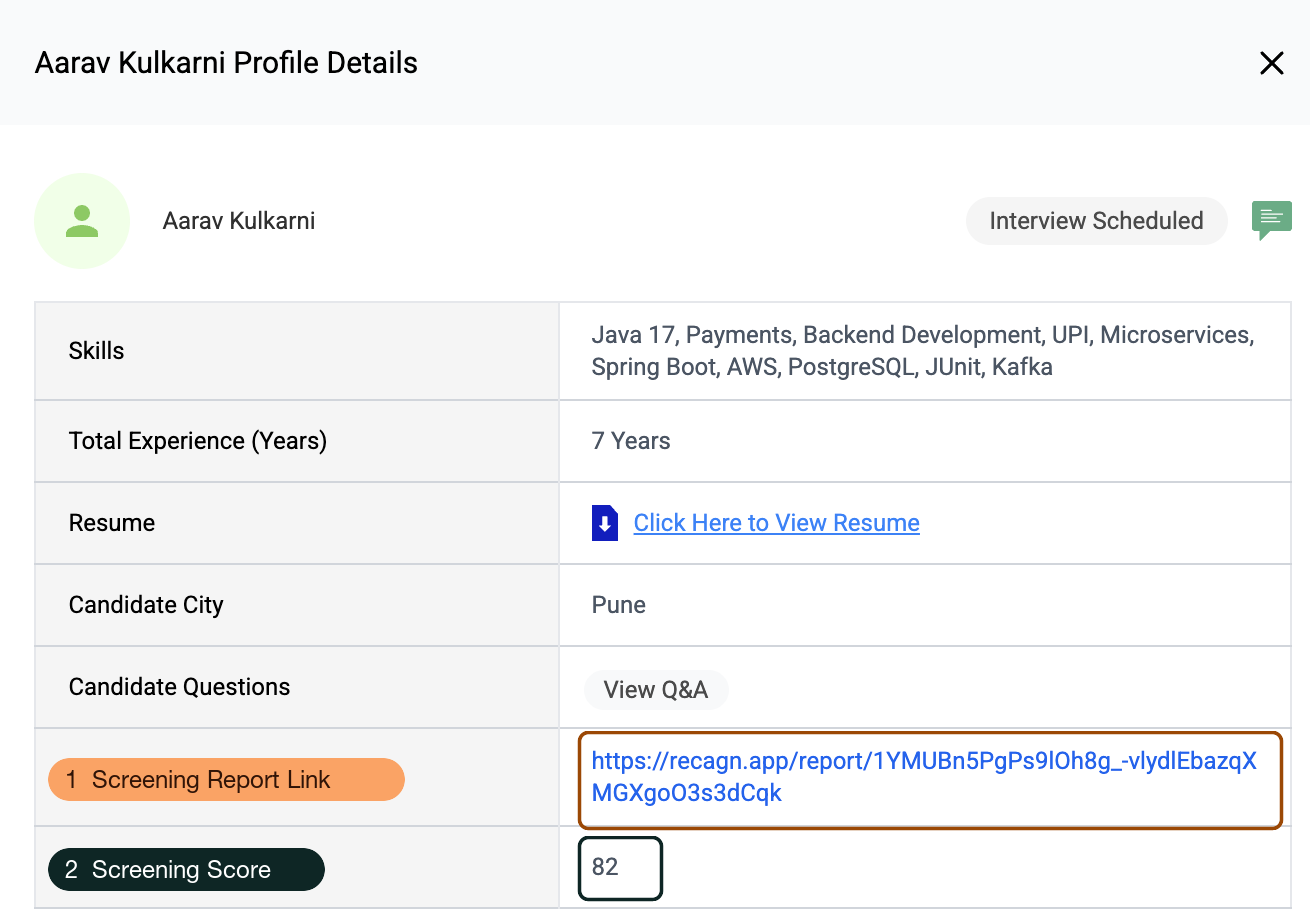
- Screening Report Link The client clicks it to open the Company Report.
- Screening Score The score from Recagn.
In the client's view of a candidate, the report link sits beside the score as a link they can click. It opens the Company Report, which needs no Recagn account and shows each interviewed candidate's answers and scores against the rubric.
What doesn't sync between Recruit CRM and Recagn today?
Nothing moves between Recruit CRM and Recagn on its own today: every step above is an export, an upload or an import that you run. The score in Recruit CRM is a copy from the day you import, and the report link stops working when it expires or is replaced.
- New candidates who apply through the Apply Link land in Recagn, not Recruit CRM, until you import them.
- Scores don't update in Recruit CRM. Import again after more candidates are matched or interviewed, with Override Data on.
- The Company Report link expires after 30 days unless you set another date when you publish it, and Replace link turns the old one off. Either way, import the new link.
- Stages move by hand in Recruit CRM (step 4). Decisions you record in Recagn don't reach Recruit CRM.
- Results leave Recagn only through the CSV you build (step 3).
A Recruit CRM integration is on the Recagn roadmap, where you can ask for early access.
If your agency runs the rest of its screening in Recagn's recruitment agency software, the Requirement, the Pool and the Company Report stay in one place, and Recruit CRM stays your record.
Questions people ask
Do I have to replace Recruit CRM to use Recagn?
No. Recagn isn't an ATS; it works alongside the one you already use. Recruit CRM stays your record of candidates, jobs, clients and stages, and Recagn screens, interviews and shortlists the candidates you send it.
Doesn't Recruit CRM already have AI screening?
Recruit CRM has AI of its own: AI resume parsing on every plan, and AI candidate matching, which uses credits (Recruit CRM pricing, read 17 Nov 2026). Recagn interviews candidates by text, voice or video and scores each answer against the role's rubric.
Which Recruit CRM plan do I need for this, and what does Recagn cost?
Pro, Business or Enterprise, or the trial: Recruit CRM's pricing page gives custom fields on all three (15 on Pro, 100 on Business and Enterprise, read 17 Nov 2026), and the guide uses two. Recagn charges by plan, not per seat: every plan includes unlimited members, and each CV read and each scored Interview draws on the plan's monthly allowance (Recagn pricing).
Why is the same report link on every candidate in Recruit CRM?
Because Recagn keeps one Company Report per Requirement, not one per candidate. The client opens one link and sees every candidate who completed the Interview, and new completions appear on the same link.