Why do clients reject candidates from an agency?
Greg Savage, who trains agency recruiters, traces a rejected shortlist to two causes: the recruiter misread the brief, or the client doesn't trust the recruiter's judgement. Both are screening problems, because a client judges an agency by the candidates it sends. Record the reason for every rejection, and fix the stage it points to.
Savage wrote that in March 2024, about permanent roles. The point holds for any desk that submits candidates to a client.
An in-house recruiter answers to a hiring manager in the same company. An agency answers to a client who can stop sending briefs. The client, not the agency, judges every candidate, and judges the agency through them.
The agency is paid when a candidate is placed. That puts steady pressure on speed, and speed pulls against the quality of each submission. A weak candidate sent fast costs an interview slot and some of the client's trust.
Indian briefs also turn on details a CV rarely settles: the notice period, current and expected CTC, and whether the candidate will relocate or work on-site. A candidate who looks right on paper can fail on any of these after the client has already met them.
Most rejection reasons point back to one of the five stages below. This mapping is this guide's own reading, not a survey finding:
- The must-have was wrong or missing. Stage 1, the intake call.
- A CV claim didn't hold up in the client's interview. Stage 4, the claim checks.
- The notice period or CTC was out of range. Stage 1, where the limits are set, and stage 3, where the candidate states them.
- The submission was too thin to sell the candidate. Stage 5, the shortlist.
The client decides who is interviewed and who is hired. The agency decides who is sent, and that is the decision this process protects.
What should you ask the client on the intake call?
Ask the client what a candidate must have to be considered at all, and what separates a good candidate from a great one. The first list becomes pass-or-fail checks, and the second becomes a weighted scorecard. The client confirms both before you screen anyone.
This is stage 1: turning the client's brief into criteria. A job description is written to attract candidates, so it often leaves out the details that decide a placement. The intake call is where you get them.
Take these questions to the call:
- What is the CTC band, and how far can it stretch?
- What is the longest notice period you will wait for?
- Is the role on-site, hybrid or remote, and in which city?
- Which two or three things rule a candidate out if they're missing?
- What does a strong answer sound like for the most important criterion?
- Who in your team decides, and by when?
Write the answers down in the client's words. You will need them when a candidate sits on the line between two buckets.
The client brief template has a field for each of these questions.
Must-haves and weighted criteria
Keep pass-or-fail checks for what truly disqualifies: the work location, a legal or licence requirement, a stated minimum of experience. Everything else gets a weight, because the client will trade it against something else.
Weights set the order of the shortlist. Two criteria the client calls equally important should carry the same weight, and one that matters twice as much should carry twice the weight.
Anchor the scale before the first interview. For each criterion, write what a 1 looks like and what a 5 looks like, in the role's own terms. Without anchors, two recruiters on one desk will score the same answer differently.
Too many pass-or-fail checks empty the pipeline. If the client lists six must-haves, ask which candidate they would still meet if one were missing. That one is a weighted criterion.
What a brief usually leaves out
Briefs are often silent on pay and notice period. The worked example at the end of this guide is a real job posting that states neither, and a scorecard drafted from it has no check for either. Only the intake call can fill that gap.
You write the criteria. The client signs them off, ideally in writing, before you send a single candidate.
How do you screen a pile of CVs for one role?
Screen CVs in two passes: first drop anyone who fails a must-have, then rank the rest against the weighted criteria. Treat every CV line as a claim to test later, not a fact. Start with your own database, because candidates you have already screened come with history.
This is stage 2. CVs arrive from job-board responses on Naukri, LinkedIn applications, referrals and the agency's own database. Each source gets the same two passes, so a referral isn't waved through and a job-board response isn't dismissed on sight. To gather board responses in one place, put an external apply link in your Naukri or LinkedIn job post.
The first pass is quick. If the CV shows that a must-have is missing, such as the location or a required licence, the candidate stops here. If the CV doesn't say, the candidate goes through, and the first round asks.
The second pass ranks. Read each CV against the weighted criteria and note what it shows for each one.
A CV can show a stated location, a degree or a job title. It can't show what the candidate owned, the numbers behind "exceeded targets", or how they handle a difficult client. Those wait for stage 3.
Your own database deserves the first look. A candidate you screened last quarter for a similar role may already have answers, notes and a client's feedback on file. That history is worth more than a fresh CV with none.
You pick who is invited to the first round. A ranking only orders the pile; it doesn't choose.
How do you screen candidates faster in the first round?
Replace the first phone screen with an async interview, which every candidate answers with the same questions at a time they choose. It removes the booking and the calls, though a phone screen still suits small pools and senior roles where the conversation matters. Either way, decide in advance which answers move a candidate on.
Stage 3 is the first conversation with the candidate. A phone screen and an async interview, also called a one-way interview, do the same job in different ways.
| Phone screen by a recruiter | Async interview (one-way) | |
|---|---|---|
| When it happens | When both are free, often in working hours | When the candidate chooses |
| Same questions for everyone | Only if the recruiter sticks to a script | Yes, fixed in advance |
| Follow-up questions | Live, as the call goes | None, or set in advance, depending on the tool |
| What's kept | The recruiter's notes | The answers themselves (text, audio or video) |
| What it costs | The recruiter's time: booking, calling, writing notes | A per-interview or plan price (see the next table) |
| What the client can see later | A summary | The answers, if the tool shares them |
Source: how each format works · a description, not a ranking
The phone screen's hidden cost is the booking. Every call needs a slot both people can make, and a missed call starts the booking again. An async interview has no slot: the candidate answers when they can, and you read or watch the answers when you can.
We found no published figure, with a method behind it, for how long a phone screen takes or how many hours an async round saves. So this guide doesn't quote one. Vendor pages make speed claims, but none we read showed how they were measured.
Whichever format you choose, write down before the first interview which answers move a candidate on. That turns the first round from an impression into a check against the scorecard.
If a tool scores the answers, the score is a recommendation. You read the answers and decide who moves on.
What an async video interview costs
The three vendors below publish a price for one more async video interview, and the table compares that price at the smallest purchase each one sells. All figures are from each vendor's own pricing page, checked 10 Nov 2026.
| Tool | Plan you need first | Video interviews included a month | Smallest purchase of extra video interviews | Price of one extra video interview |
|---|---|---|---|---|
| Hyring | None: the Free plan ($0) works, with 1 seat and 1 active job post. Pro is $79 a month billed yearly, or $99 billed monthly, with 5 seats and 10 active job posts | 50, on every plan, Free included | 1 credit, pay-as-you-go | $5 (₹468), for the 1st to 99th extra credit |
| Interviewer.AI | Essential, $199 a month billed monthly, with 3 job posts. Extra credits need an active Essential or Professional plan | 50, 20 minutes each | A pack of 50 credits, $150 (₹14,034) | $3 (₹281), in the smallest pack |
| UnoJobs | None: pay per interview | None | 1 interview | ₹500, flat at any volume, for a 20-minute video interview |
Source: each vendor's own pricing page, checked 10 Nov 2026 · GST not stated on any of the three pages · USD converted at ₹93.56 (Wise mid-market rate, 17 Nov 2026)
The plan column matters as much as the price. Hyring's Free plan has one seat and one active job post, which limits an agency working several roles at once. Interviewer.AI sells extra credits only on top of a paid Essential or Professional plan.
This guide doesn't divide a plan price by its included interviews. Plan prices also buy seats, job posts and features, so the result would be a price nobody pays.
Talview, iMocha and Eklavvya publish no price for their interview products on their pricing pages (checked 10 Nov 2026). HireVue, InCruiter and HirePro published none when we checked on 6 Nov 2026.
For more vendors, the plan price divided by included interviews, and yearly billing, see AI interview pricing in India.
When a phone call is still the better first round
- A small pool. With a handful of candidates, a call is quicker than setting up an interview.
- Senior or relationship roles. There the call is itself part of the pitch to the candidate.
- Candidates who can't easily record answers. A weak connection or no quiet place to record makes a call fairer.
An async interview doesn't sell the role to the candidate the way a good call can. If the candidate needs persuading, keep a call in the process, after the async round or alongside it.
How do you check a candidate's claims before the client does?
Ask for the method behind every claim a client will test: years of experience, what the candidate owned, and the numbers they quote. Compare the CV's dates with the years it claims, and the answers with the CV. A claim that doesn't hold up is a question for the candidate, not an automatic rejection.
This is stage 4. It happens before the submission, not after a client interview goes badly. The client will test the same claims, so find the gaps first.
Run three checks:
- Dates against years. A CV that says "3+ years" above a single role that started last year has a gap to explain. Count from the start dates, not from the summary line.
- Ownership. Ask: "What did you own, and what did someone else build or decide?" An answer full of "we" is worth a follow-up.
- Numbers. Ask: "How many leads a month did you work, and how many enrolled?" A conversion rate without the count behind it is hard to check.
Use the stage 3 answers as your evidence. If the first round asked the right questions, the claims are already on record in the candidate's own words, and you can compare them with the CV line by line.
A mismatch is not proof of dishonesty. People round up dates, count internships, or describe a team's result as their own. Ask the candidate, note the answer, and then judge whether it changes your view.
You decide whether a mismatch matters, and you ask the candidate before you decide.
What should a shortlist sent to the client contain?
For each candidate, a client-ready shortlist shows every must-have met or not, the weighted scores with their evidence, the notice period and the CTC. Put your recommendation first and keep the evidence one click away. The client decides who to interview.
This is stage 5, the submission. For each candidate, include:
- a two-line summary of who they are;
- each must-have, met or not met;
- the score on each weighted criterion, with one line of evidence from the answers;
- notice period, current and expected CTC, and location;
- the claim checks you ran, and what they found;
- your recommendation, and the reason for it;
- what you didn't check.
The last line matters. Saying what you didn't check tells the client where to look in their own interview. It also keeps your judgement credible when a gap shows up later.
The client shortlist report template has a section for each of these. To send one candidate before the rest are ready, use the candidate submission format.
A submission like this answers both of Savage's causes. The client can see that the brief was read, because every must-have is listed against it. The client can also see the evidence behind your judgement, instead of taking it on trust.
Share contact details only for the candidates you are putting forward. Tell candidates up front how their answers are used and who will see them; what candidates see and agree to shows one way to set that out.
Which screening metrics should an agency track?
Track three numbers per client: submission-to-interview ratio, time to submit, and the reason for each rejection. No independent benchmark for these ratios was found, so compare each client with its own history. The trend tells you which stage to fix.
- Submission-to-interview ratio: candidates submitted divided by candidates the client agrees to interview, per client and role. A ratio of 3 means the client met one candidate in three.
- Time to submit: days from the signed-off brief to the first submission.
- Rejection reasons: each rejection coded to the stage that would have caught it: brief, CV, first round, claims or submission.
We searched for an independent benchmark for these ratios in November 2026 and found none with a published method, so this guide doesn't quote one.
Read the three together. A rising ratio with rejections coded "brief" points to the intake call. A fast time to submit with rejections coded "claims" points to stage 4: candidates are going out before they are checked.
The numbers point at a stage. You decide what to change, and whether a client's pattern says more about the client than about your process.
How Recagn does this
Recagn is our product. This section takes one brief through the five stages above, using a real run scored by Recagn on 8 Nov 2026. The brief is adapted from a real public job posting, with company details removed. The candidates are invented, and their answers were performed from a script.
The brief
The role is an inside sales and admissions counsellor at an EdTech institute in Pune. It is on-site, Monday to Saturday, for 1 to 3 years' experience, with fixed pay plus incentives. The posting gives no salary figure and no notice period.
That is the gap the intake call in stage 1 exists to close.
The CVs
For stage 2, Recagn reads each CV in your candidate database against the locked rubric and gives it a match score with a short reason. This run's export holds no match results, so none are shown here. Searching the database and reading every CV comes off your plate; who gets invited stays yours.
The criteria: a scorecard, which Recagn calls a rubric
Recagn drafted the rubric from the brief. It has three hard gates: Pune on-site availability, 1 to 3 years of B2C or inside sales experience, and clear spoken communication.
It has five weighted criteria: B2C sales and conversion, 25%; counselling and objection handling, 25%; follow-up discipline, 20%; target-driven ownership, 15%; and CRM and reporting fluency, 15%. This rubric's cut-offs are 3.6 for Qualified and 2.8 for Maybe.
For this example the rubric was locked unedited, to show Recagn's draft as it came. The brief states neither pay nor notice period, so the draft has no gate for either. Adding them is the recruiter's edit, from the answers to the stage 1 questions.
Turning a client's job description into a scored rubric comes off your plate. What the role needs stays yours: you edit and approve the rubric before anyone is invited.
Why one criterion's wording matters
Each criterion adds score × weight ÷ Σweight (100 here) to the ruler. End to end they reach the weighted score; the dashed lines are the rubric's cut-offs.
- 1Spring Boot services in production, 3+ yearsSpring Boot services in production, 3+ yearsweight 30 · score 44
- 2Owned a payments or ledger serviceHandled payment reversals in productionweight 25 · score 24
- 3Kafka or RabbitMQ in productionKafka or RabbitMQ in productionweight 15 · score 33
- 4Code review and mentoringCode review and mentoringweight 30 · score 44
3.353.85Recagn recommends MaybeQualified
Σ(score × weight) ÷ Σweight = (4×30 + 2×25 + 3×15 + 4×30) ÷ 100(4×30 + 4×25 + 3×15 + 4×30) ÷ 100 = 3.353.85
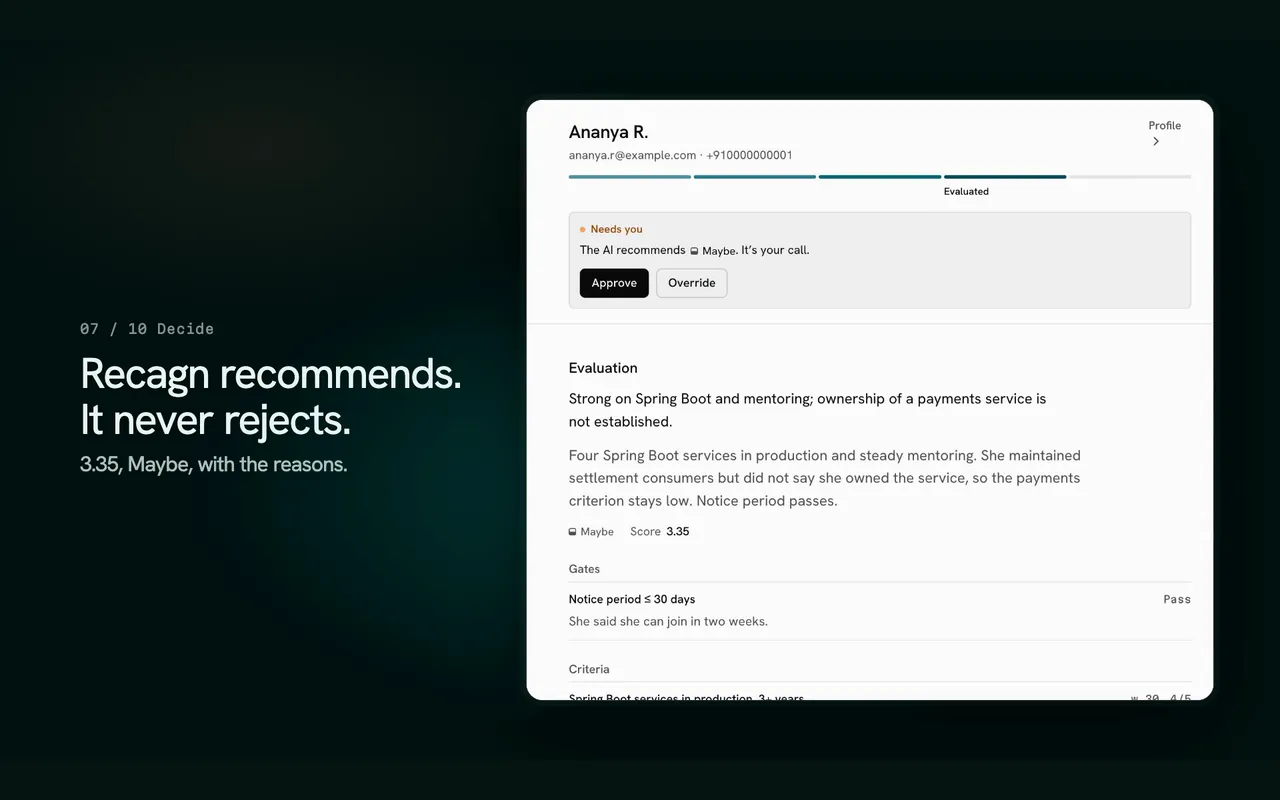
This figure uses a different, invented candidate from Recagn's homepage, for a Senior Java Developer role. Her draft score is 3.35, a Maybe; reword one criterion to what the client said on the call, and the same answers give 3.85, a Qualified. The wording is yours to set, and the bucket it produces is only a recommendation. The arithmetic is set out step by step in how AI interview scoring works.
The interviews
Recagn drafted seven questions, each linked to the criteria or the gate it tests. The first asks the candidate to pitch a programme by voice, as if on a call, because the job is selling by phone. The other six accept text, voice or video, and the last, which confirms Pune availability, also accepts a document.
Four invented candidates answered: the first question by voice, the rest as typed text. Each interview used one credit, because Recagn uses three credits only when an answer is video.
Running the first-round interviews, at whatever hour the candidate chooses, comes off your plate. The questions and the hard gates stay yours.
The scores and recommendations
Ordered by Recagn's recommendation for this figure (the real report follows your decisions, and none is made yet); each candidate's one-line summary is left out.
Inside sales / admissions counsellor An EdTech company in Pune
- NRecagn recommends Qualified
- B2C Sales & Conversion Skill4/5
- Counselling, Persuasion & Objection Handling4/5
- Follow-up Discipline & Pipeline Management5/5
- Target-Driven Ownership & Motivation5/5
- CRM & Sales Reporting Fluency5/5
8 corroborationsauthenticity 2/10
Your decision: not made yet
- TRecagn recommends Maybe
- B2C Sales & Conversion Skill3/5
- Counselling, Persuasion & Objection Handling3/5
- Follow-up Discipline & Pipeline Management3/5
- Target-Driven Ownership & Motivation3/5
- CRM & Sales Reporting Fluency3/5
1 contradiction, 2 inflations, 5 corroborationsauthenticity 3/10
Your decision: not made yet
- KRecagn recommends Disqualified
- B2C Sales & Conversion Skill2/5
- Counselling, Persuasion & Objection Handling2/5
- Follow-up Discipline & Pipeline Management2/5
- Target-Driven Ownership & Motivation3/5
- CRM & Sales Reporting Fluency2/5
1 contradiction, 1 inflation, 7 corroborationsauthenticity 1/10
Your decision: not made yet
- DRecagn recommends Disqualified
- B2C Sales & Conversion Skill1/5
- Counselling, Persuasion & Objection Handling1/5
- Follow-up Discipline & Pipeline Management1/5
- Target-Driven Ownership & Motivation2/5
- CRM & Sales Reporting Fluency1/5
4 corroborationsauthenticity 1/10
Your decision: not made yet
The figure shows the client shortlist report, which Recagn calls the Company Report, for this run. Recagn scored each criterion from 1 to 5 against its anchors, then combined the scores by a fixed rule: each score times its weight, added up, divided by the total weight. The result is a recommendation, and you decide.
- Nisha P. scored 4.50. Recagn recommends Qualified.
- Tanvi J. scored 3.00, between the 2.8 and 3.6 cut-offs. Recagn recommends Maybe.
- Karan B. scored 2.15, below 2.8. Recagn recommends Disqualified on score.
- Debashish M. scored 1.15. Recagn recommends Disqualified.
The client report shows each criterion's score and the recommendation, not the weighted total. The totals above are worked out from the report's scores by that same rule.
Recagn recommends. Only you can reject a candidate. A Disqualified recommendation moves no one out of the pipeline: you approve or override each recommendation, then make your own decision. In the figure, none has been made yet.
Scoring the answers against the rubric comes off your plate. Whether a score holds stays yours.
The claim checks
Tanvi J.'s invented CV says "3+ years" of inside sales experience. Its own dates show one listed role, starting in Aug 2025, and a degree completed in 2025.
Recagn's consistency check compares what a CV claims with what the candidate says in the interview. For Tanvi J. it returned 1 contradiction, 2 inflations and 5 corroborations. The report shows these counts, and this page doesn't say which claims were flagged.
Recagn shows the findings. You decide whether one matters, and you ask the candidate first.
Recagn's authenticity check also gives each candidate a reading from 0 to 10 for signs that an answer wasn't their own. It sits beside the score, never changes it, and never rejects anyone; you decide whether it matters.
Checking CV claims and flagging likely cheating come off your plate. Whether a flag matters stays yours.
The report to the client
Recagn drafts the client report from the scored interviews, and you share it with the client as a link. It lists every candidate who completed the interview, ordered by your decision: Selected first, then Maybe, then candidates not yet decided, then Rejected.
For each candidate, you choose whether the client sees the full name, email and phone, or only initials with email and phone hidden. The client can download the CV of every candidate who finished the interview, whatever that setting. The link expires after 30 days by default.
The client marks each candidate Interview, Pass or Hired on the report, and those marks come back to you.
The report doesn't let you leave a completed candidate off it. The notice period and CTC appear only if your questions asked for them, and this run's questions didn't.
Drafting the client report comes off your plate. The order the client sees, and which candidates show by full name or by initials, stay yours.
What an agency's whole desk gets from Recagn, and what it costs per agency, is set out on Recagn as recruitment agency software.
Watch it run
Recagn's 3½-minute product demo shows the same steps on screen.
In this run, Recagn drafted the rubric, ran four interviews, scored them, checked the CV claims and drafted the client report. The edits to the rubric, the decision on each candidate and what the client sees stayed with the recruiter.
Questions people ask
Is Recagn an ATS?
No. Recagn screens candidates for a role and works alongside the applicant tracking system you already use. It keeps the candidates you screen, but it doesn't run the rest of your desk.
Can an async interview replace the recruiter's phone call?
Not every one. It can replace the first screening call, where every candidate gets the same questions, but the call that sells the role or negotiates CTC and notice period stays with the recruiter. Decide which calls you keep before you switch.
How does Recagn's free plan compare with Hyring's?
For video interviews, Hyring's gives more. Hyring's Free plan includes 50 credits a month at $0, and one AI video interview uses one credit, going by Hyring's pricing page, read 10 Nov 2026. After the first 30 days, Recagn Free includes 5 credits a month and no video interviews.
What does a first-round interview cost on Recagn?
At most ₹50 per text or voice interview on Starter, monthly (₹49.98; ₹58.98 with 18% GST), and at most ₹150 per video interview (₹149.95; ₹176.94 with GST). A video interview uses three credits and any other interview uses one; see Recagn pricing.
What is a good submission-to-interview ratio?
There is no reliable public benchmark: we found none with a published method in November 2026. Measure your own ratio per client and role, and watch whether it falls after you change a stage.
Are candidates told that Recagn uses AI to evaluate their answers?
Yes. Before they start, candidates see what the interview records and agree that AI helps score their answers, and that a person reviews their answers and makes every decision. See what candidates see and agree to.
Should a must-have be pass-or-fail or a weighted criterion?
Pass-or-fail only when missing it rules the candidate out whatever else they offer, such as the work location or a licence. Everything the client would trade against something else gets a weight. Agree the split with the client on the intake call.